Findie vs Upwork vs hiring a creative agency: which model actually works?
Publicado
27 de julio de 2026
4 min de lectura
Three ways to hire creative talent. Each solves a different problem. Here is how to know which one fits your project before you spend time or money on the wrong one.
Most companies that struggle to hire creative talent are not struggling because good talent is hard to find. They are struggling because they chose the wrong model for what they actually needed.
The question is not "where do I find a designer?" The question is "what kind of problem am I solving?" Answering that first makes everything else faster and cheaper.
Here is an honest breakdown of the three most common models: open marketplaces like Upwork, traditional creative agencies, and curated platforms like Findie.
What open marketplaces like Upwork do well
Upwork and similar platforms work on volume. Anyone can create a profile, post a service, and start receiving work. For the company hiring, that means access to a large pool of talent at almost any price point, often within hours.
That model works well for specific, contained tasks. You need a logo variation, a quick illustration, a one-page layout. The scope is clear, the risk is low, and speed matters more than strategic fit.
Where it breaks down is on anything that requires judgment, consistency, or brand understanding. The hiring burden falls entirely on you. You receive hundreds of applications and have to evaluate portfolios, filter for quality, assess communication, and verify whether the person can actually deliver at the level your project requires. That process takes time, and most companies underestimate how much.
The race-to-the-bottom pricing also has consequences. Designers who compete on price are often optimizing for volume, not quality. The work reflects that.
What traditional creative agencies do well
Agencies solve a different problem: accountability and full-service management. You hand over a brief and a budget, and the agency handles everything from strategy to final delivery. For large campaigns, brand launches, or projects where you do not have internal capacity to manage a creative process, that model has real value.
The challenges are often structural. Agency overhead can be significant, and multiple layers of management may sit between you and the talent. The senior creative who pitches the account is not always the person leading the day-to-day execution. Timelines tend to be longer, and revisions can be more expensive. While the output is often polished, internal processes and account structures can sometimes create distance from the original creative challenge.
For startups and growing companies, the question is often not whether they need senior talent, but whether they need the additional layers of management that come with a traditional agency. Many complex projects require expertise and strategic thinking, without necessarily requiring a full-service structure.
What curated platforms like Findie do well
A curated platform sits between the two. It does the vetting work that open marketplaces leave to you, and it delivers the talent access that agencies charge a premium for, without the overhead.
At Findie, less than 20% of applicants are accepted into the network. What gets evaluated is not just the portfolio, but the designer's process, their communication, and their track record with real clients. By the time a profile appears in the platform, the filtering has already happened. Companies are matched with talent based on project scope, industry, timeline, and budget. Instead of browsing hundreds of profiles, they start with a curated shortlist of professionals who have already been vetted for quality and experience.
When you submit a brief, the match is strategic. Not algorithmic. A team reviews the project scope, the timeline, the visual direction, and the budget, and recommends the right profile for that specific project. The result is a senior creative who understands your context, not just someone who was available.
Where this model is not the right fit: very small or very fast tasks where cost is the primary driver, or projects without enough definition to brief someone properly. A curated match requires a real brief. If you cannot describe what you need, the process stalls.
Direct comparison
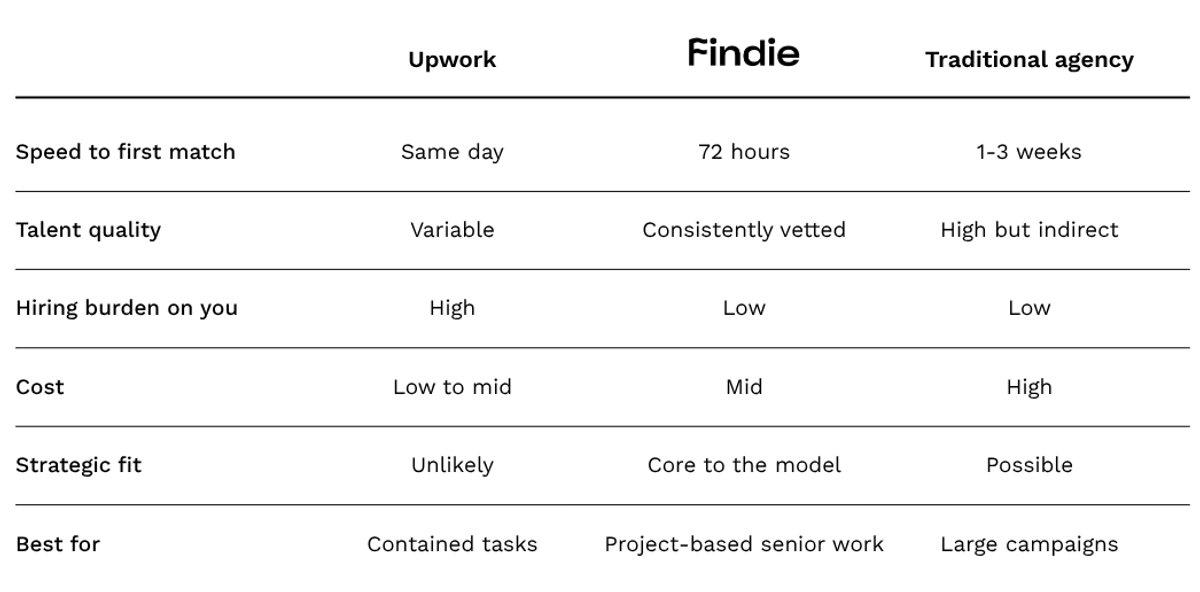
How to choose
Three questions worth asking before you decide:
First, how much time do you have to evaluate candidates? If the answer is very little, open marketplaces will cost you more in evaluation time than you save on price.
Second, do you need someone who understands your brand, or just someone who can execute a defined output? If brand understanding matters, the vetting has to happen somewhere. Either you do it, or the platform does it for you.
Third, what is the actual scope? A single deliverable with a tight deadline might not need a curated match. A brand identity, a product design, or an ongoing creative relationship almost always does.
The right model depends on the level of expertise, involvement, and structure your project requires. What rarely works is using an open marketplace for a project that requires judgment, or paying agency prices for a project that does not require full-service management.
If you are building something that deserves the right creative partner, that is the problem Findie is built to solve.